
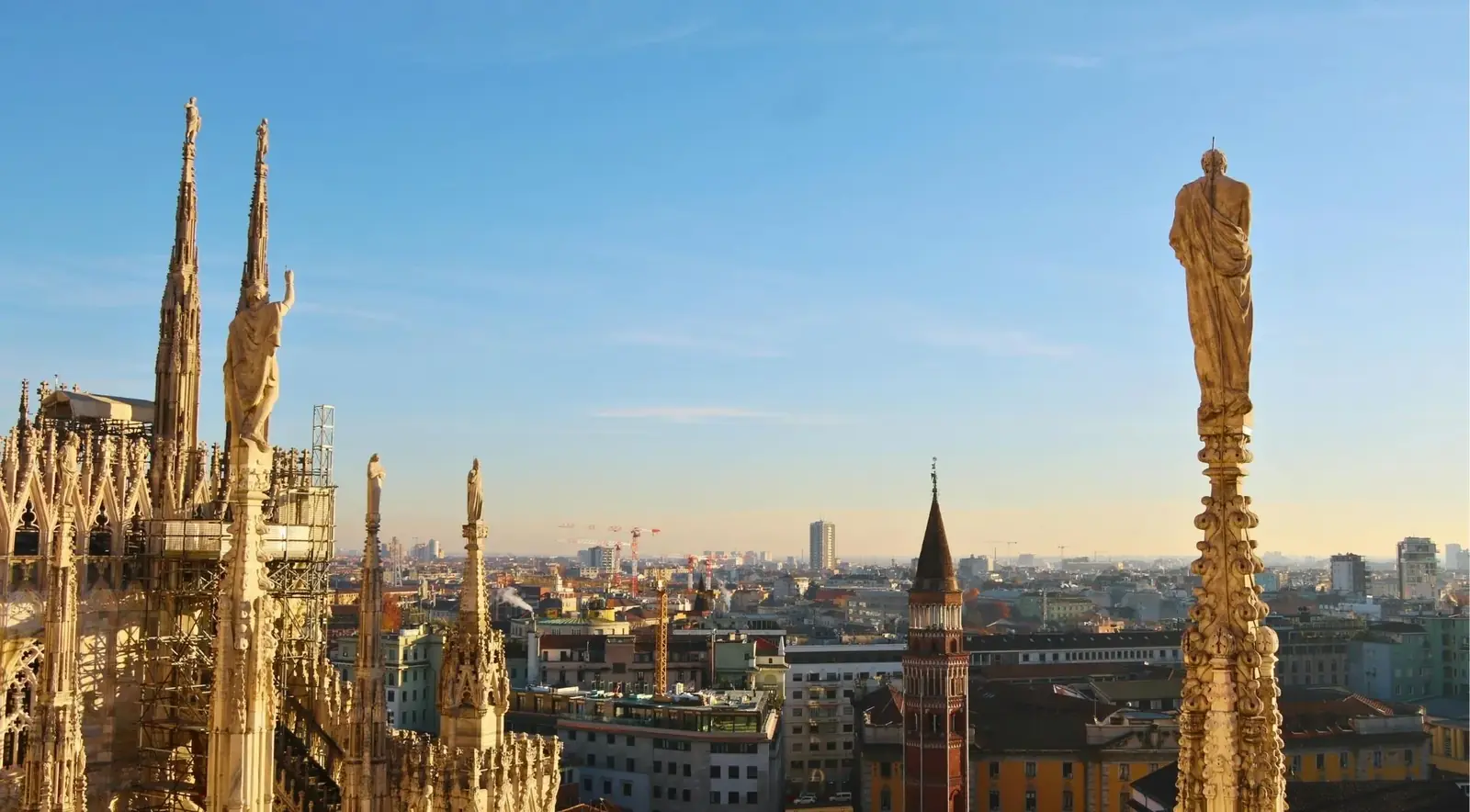
The short answer
The Duomo complex is open every day of the year, though the hours move with the season. Two parts keep their own closing days: the Museum on Wednesdays, the Crypt of St Charles on Sundays. Entry is by timed slot, and the slot matters more than the month. Only the rooftop terraces are outdoors — 45 to 60 minutes of a two to three hour visit — and the heat and the crowd up there change more through the day than between months.
If you are still choosing dates for Milan, April, May, September and October are the most comfortable months on the terraces. Average daily highs at the Milano Brera observatory run 64°F to 76°F in those months, against 85°F to 86°F in July and August. The terraces are white marble with almost no shade; in summer 2026 the cathedral staffed a first-aid post up there from noon to 5pm. For a quieter city, January is where Milan's hotel figures point, though they count the city, not the cathedral queue.
Once your Milan dates are fixed, choose the entry time. The 9am opening is the only slot with nobody admitted ahead of you. Sunset moves more than four hours across the year: from November to February it falls before the 6pm last entry, so an afternoon ticket reaches the roof as the city lights come on. In summer the sun sets long after the terraces close, and the cathedral's Thursday evening openings, from mid-June to mid-September, are the way up.
- Shortest wait, any month
- The 9am opening slot
- Lowest light on the terraces
- The last slot before closing
- Sunset on an ordinary ticket
- Late afternoon, November to February
- Sunset in summer
- Thursday evening, mid-June to mid-September
- Hottest and most exposed
- Midday in July and August
- Open every day · 9am to 7pm on a standard day, last entry 6pm
- First-aid post on the terraces · noon to 5pm, June 15 to September 13, 2026
- July average high · 86°F (29.9°C) at Milano Brera
- Outdoors on your ticket · about 45 to 60 minutes of a 2–3 hour visit
Why the entry time comes first
Tickets to the Duomo are sold for a specific entry time, so the hour is a live choice in a way the month usually is not. It is also the choice with the most behind it. Four of the five areas your ticket covers — the cathedral floor, the Duomo Museum, the archaeological area under the piazza and the Crypt of St Charles — are enclosed, lit the same way in February as in July, and unaffected by anything happening outside. The terraces are the exception, and they are where the hour lands.
The cathedral's own arrangements say the same thing. Between June 15 and September 13, 2026 it sets up a staffed first-aid post on the terraces, open from noon to 5pm, along with drinking-water points, and its guidance for those months is that the hottest part of the day is "not recommended for vulnerable individuals, such as those with cardiorespiratory or mobility conditions." Nothing comparable is published about any month. The intervention is aimed at a block of hours.
Two entry times do most of the work. The 9am opening is the only slot with nobody admitted ahead of you, and in summer it is also the coolest hour you can be up there. The last slot before closing gives you the lowest light on the marble and a thinner crowd than the middle of the day, at the cost of less margin if you want to see everything indoors as well. Midday in July or August is the combination to avoid: peak heat on an unshaded surface, the longest wait, and flat overhead light.
The two ways to see sunset from the roof
This is where the month genuinely changes the answer, and it runs opposite to what most visitors expect. Sunset from the terraces is a winter possibility on an ordinary ticket and a summer event you have to book separately.
In midwinter the sun goes down between about 4:40pm and 5:10pm, and the last entry is 6pm with the terraces closing at 7pm. A normal afternoon ticket puts you on the roof for the light and for the first of the city coming on below. In June the sun sets around 9:15pm — more than two hours after the terraces have shut. No standard ticket reaches it.
What does reach it is Serate d'Incanto, the cathedral's own Thursday evening opening with live music, which ran from June 11 to September 10 in 2026. Its start times follow the sunset curve, not the clock: 8:30pm in June and July, 8pm in August, 7:30pm in September, with the terraces closing at 10pm, 9:30pm and 9pm respectively. Lift access was €20 full price and €10 reduced. Separately, terrace closing extends to 8pm on Fridays, Saturdays and Sundays from June 5 to September 13, which buys an extra hour of evening without reaching sunset.
Dates for these openings are published one season at a time, so treat the 2026 dates above as the shape of the offer and not a timetable for next year, and check the cathedral's own notices before planning an evening around them.
Check your own date
The terraces are the part of the complex the weather reaches, and they can close at short notice in storms, high wind or ice. Put your date in below for the expected temperature, rain, wind and sunset time, and for what time the terraces are scheduled to close that day.
Month by month
Temperature and rainfall below are long-run averages for the Milano Brera observatory, the city-center station about a mile north of the cathedral. The last column is the City of Milan's own count of nights booked in the city's accommodation during 2024, shown against the busiest month — a measure of demand on Milan, not a count of people inside the Duomo. Sunset is for the 15th of each month.
| Month | Avg high | Avg low | Rain | Wet days | Sunset | Daylight | City hotel demand |
|---|---|---|---|---|---|---|---|
| January | 45°F (7.3°C) | 36°F | 62 mm | 6.1 | 5:06pm | 9h 06m | 67% |
| February | 49°F (9.7°C) | 38°F | 58 mm | 5.5 | 5:50pm | 10h 24m | 76% |
| March | 58°F (14.7°C) | 45°F | 58 mm | 5.6 | 6:29pm | 11h 52m | 83% |
| April | 65°F (18.4°C) | 52°F | 86 mm | 8.3 | 8:09pm | 13h 30m | 93% |
| May | 74°F (23.2°C) | 59°F | 97 mm | 8.4 | 8:46pm | 14h 53m | 99% |
| June | 82°F (27.5°C) | 66°F | 73 mm | 6.8 | 9:13pm | 15h 39m | 94% |
| July | 86°F (29.9°C) | 70°F | 68 mm | 5.1 | 9:09pm | 15h 20m | 100% |
| August | 85°F (29.5°C) | 70°F | 74 mm | 5.6 | 8:31pm | 14h 08m | 82% |
| September | 76°F (24.4°C) | 62°F | 94 mm | 6.4 | 7:35pm | 12h 34m | 92% |
| October | 64°F (18.0°C) | 54°F | 97 mm | 7.6 | 6:39pm | 11h 00m | 100% |
| November | 53°F (11.9°C) | 45°F | 119 mm | 8.7 | 4:54pm | 9h 32m | 83% |
| December | 46°F (7.6°C) | 37°F | 65 mm | 6.6 | 4:40pm | 8h 44m | 80% |
The rain column is a monthly total in millimeters, not a daily rate, and the wet-days column counts days with at least 1 mm. Milan's wettest month is November at 119 mm, which matters for what you pack and almost not at all for whether the visit works, since most of the complex is indoors. An average high is an average: April days in the low 80s°F and July days in the 70s°F both happen.
How busy Milan gets, and what that does not tell you
Nobody publishes monthly attendance for the Duomo. About 3.5 million people entered the cathedral in 2023 and the Duomo Museum recorded about 786,000 entries in 2024, but both are annual totals with no breakdown. The nearest monthly series is the City of Milan's record of nights booked in the city's accommodation, compiled from police-portal registrations, and it needs reading carefully before anyone leans on it.
On that series, demand across 2024 ran from January at about two-thirds of the busiest month up to July and October, which finished within a fraction of a percent of each other at the top. The whole spread from lightest to heaviest is around 1.5 times — a flat curve for a major destination, and the first thing it tells you is that Milan does not really empty out.
The second thing is that this is a business city. The April, October and late-February peaks are lifted by Salone del Mobile, the autumn trade-fair calendar and the fashion weeks, which fill hotel rooms without necessarily filling a cathedral queue, and August runs against the usual leisure pattern for the same reason: business travel stops and the city empties while the rest of Italy is on holiday. So treat the column as an indicator of pressure on Milan, and the entry time as the thing you can actually act on.
What each season gives the terraces
April and May, then September and October. Average highs from 64°F to 76°F, and enough daylight to fit the indoor half and the roof into one afternoon without rushing. The cost is company: May, September and October all sit near the top of the city's hotel demand.
June to August. The longest days and the only scheduled evening access, but also 85°F to 86°F averages on open marble in July and August, and the hours the cathedral itself staffs a first-aid post. A 9am slot handles most of this; a 1pm slot does not.
November to February. The terraces gain something here that no other season offers: sunset falls before the last entry, so an ordinary ticket reaches the light and the lit city. The costs are real — 45°F to 53°F average highs, the shortest days of the year, and the Po Valley's fog and haze, which is exactly what a long view cannot survive. On a genuinely clear winter day the Alps show up on the horizon behind the spires. That is luck, not a plan, and it is not a reason to pick a month.
March. The driest month on the record at 58 mm, still cool at a 58°F average high, and lighter on hotel demand than April. An underrated compromise if you mind crowds more than temperature.
Hours, closing days and weather closures
On a standard day the cathedral, terraces and archaeological area open at 9am and close at 7pm, with the last ticket sold at 5:50pm, the last entry at 6pm and closing procedures starting at 6:30pm. On the extended summer dates — Fridays to Sundays between June 5 and September 13, 2026 — closing moves to 8pm with the last entry at 7pm. The Duomo Museum is closed on Wednesdays; the Crypt of St Charles is closed on Sundays and religious festivals.
The terraces can close temporarily in heavy rain, storms, high wind or ice, and the lift can be suspended separately. The cathedral does not publish a wind speed or a rainfall figure that triggers this, and different sources quote different ones, so there is no threshold to repeat here — the honest version is that it is decided on the day. That makes it a live check, not a seasonal one.
A note on which ticket you hold, because the figures differ. A stairs ticket is 251 steps. A lift ticket takes you to the first level only: the second level of the terraces and the entire descent are stairs either way, so a lift ticket is not a step-free visit. Prices and what each covers are set out in our guide to opening hours and prices, and the choice between climbing and riding in our stairs or lift comparison.
FAQ
Frequently asked questions about timing your visit
What is the best time of day to visit the Milan Duomo?
The 9am opening slot is the only entry of the day with nobody admitted ahead of you, and it is the coolest hour on the terraces in summer. The last slot before closing is the other good choice, trading a shorter wait for lower, warmer light on the marble.
Can you see the sunset from the Duomo rooftop?
From November to February you can, on an ordinary ticket: sunset falls around 4:40pm to 5:50pm, comfortably before the 6pm last entry. In summer the sun sets long after the terraces close, so the cathedral's own Thursday evening openings, which run from mid-June to mid-September, are the way up.
Is the Milan Duomo open all year?
Yes, every day of the year, though the hours move with the season. The Duomo Museum is closed on Wednesdays and the Crypt of St Charles is closed on Sundays and religious festivals. The rooftop terraces can close at short notice in storms, high wind or ice.
What month has the best weather for the Duomo rooftop?
April, May, September and October. Average daily highs at the Milano Brera observatory run 65°F in April, 74°F in May, 76°F in September and 64°F in October, which is warm enough to linger on an open marble terrace without the 85-86°F that July and August average.
How hot does the Milan Duomo rooftop get in summer?
July averages a daily high of 86°F and August 85°F at the Milano Brera observatory, on white marble with almost no shade. The cathedral sets up a staffed first-aid post on the terraces from noon to 5pm between June 15 and September 13, and advises that the hottest part of the day is not recommended for visitors with cardiorespiratory or mobility conditions.
Which month is quietest at the Milan Duomo?
Nobody publishes monthly attendance for the Duomo itself. On the City of Milan's hotel figures, January is where demand is lightest, at about two-thirds of the busiest month, but that counts nights booked across the whole city, not people in the cathedral queue.
How we know
Opening hours, closing days, prices and the summer program come from the cathedral's own site and its own ticket shop: the Duomo and Terraces product pages on ticket.duomomilano.it, the access-updates notice, the spring and summer special-openings page, the Serate d'Incanto listing, and the heat-and-services notice quoted above, all read on September 18, 2026.
Temperature and rainfall are 1991–2020 normals for the Milano Brera observatory, computed here from ARPA Lombardia's published daily series for that station (1763–2025) rather than taken from a reanalysis grid. All twelve months have thirty complete years behind them; 58 daily precipitation values and two temperature values are missing from roughly 10,950, which does not move the monthly figures.
Sunset times and daylight are computed for 45.464°N, 9.190°E using the standard NOAA method, which agrees with published tables to within a few minutes. They are shown for the 15th of each month, a date never close to a daylight-saving changeover. The date checker computes them for your own day.
City demand is the Comune di Milano's monthly series of nights booked in the city's accommodation for 2024, compiled by its statistical service from Milan and Monza-Brianza police-portal registrations.
Forecasts in the date checker come from the Open-Meteo forecast API inside its roughly sixteen-day window, and from the Brera averages above beyond it. Beyond that window the card is showing a long-run average and not a forecast, and it says so on the card.
Where the evidence stops
- There is no published monthly attendance series for the Duomo itself. The city hotel figures are a proxy for pressure on Milan and cannot tell you how long the line at the cathedral door will be on your day.
- The cathedral does not publish the conditions under which the terraces close, so this page names no wind or rain threshold. What these numbers cannot tell you is whether the terraces will be open on one particular morning; that is decided on the day.
- Special and extended opening dates are published one season at a time. The 2026 dates are given above; 2027 dates were not published when this page was written and are not extrapolated.
- The cathedral's site also carries an older notice giving a 5pm ticket cut-off and a 6:30pm close. The dated product pages in its own ticket shop are more specific and more recent, so this page follows those and recommends checking the official notices for your date.
- Alps visibility from the terraces is described in press and enthusiast sources but is not published as a series, so it appears here as a bonus and carries no recommendation.
- Conditions were last checked against the cathedral's notices on September 18, 2026. If you are reading this well after that, check the official notices for current closures before booking a specific slot.
Related Milan Duomo guides
- The rooftop terraces — what you actually walk on, and what you see from each level.
- Stairs or lift — 251 steps, or the lift to the first level and stairs from there.
- Opening hours and prices — every ticket, what it covers and what it costs.
- Buying tickets online — which ticket to book and where.
- Dress code — shoulders and knees, enforced on the roof as well as inside.
- Inside the cathedral — the stained glass, and the hours it looks best.