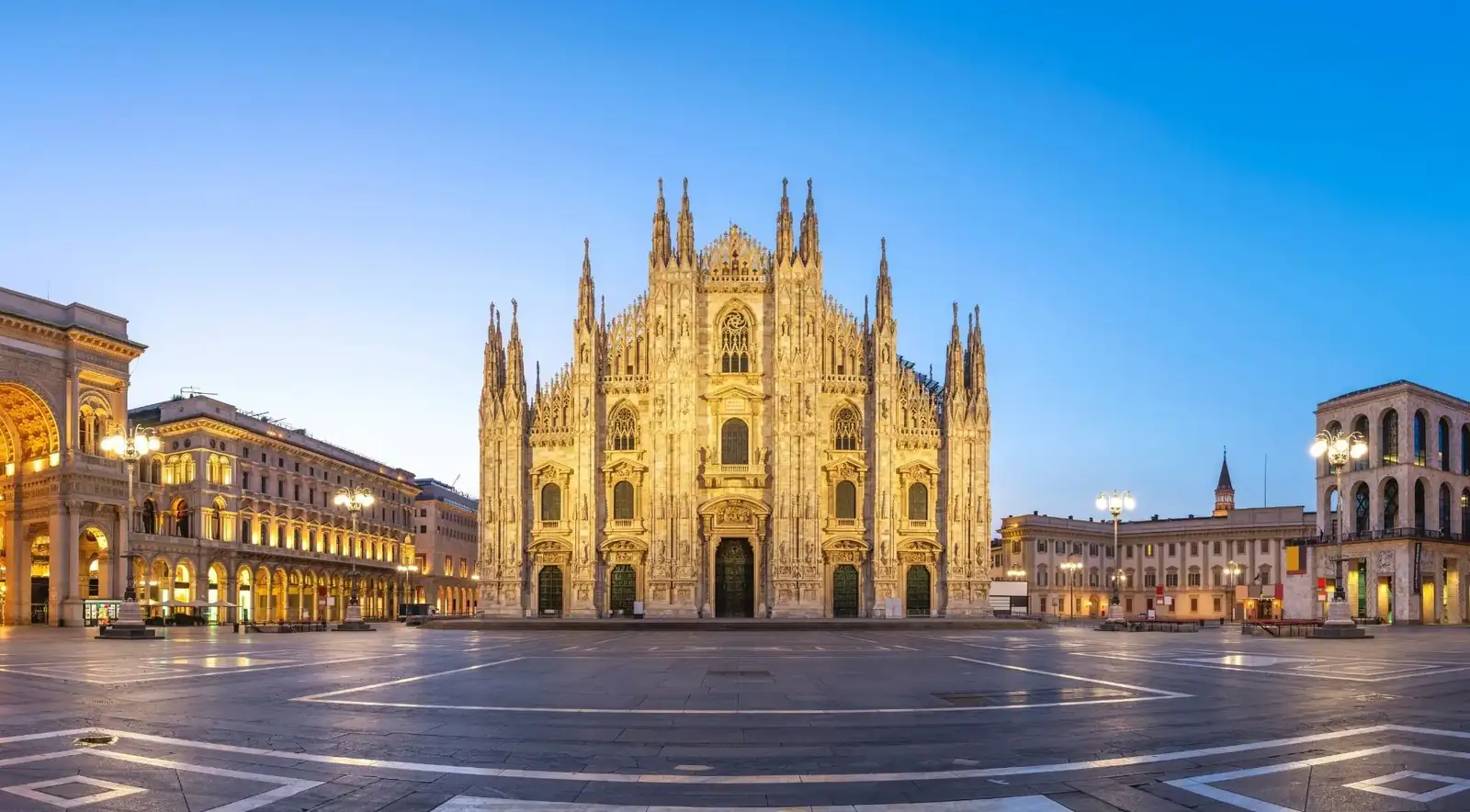
The Milan Duomo took 579 years to build. Ground was broken in 1386. The last bronze doors were inaugurated in 1965. In between: fourteen dukes, four centuries of foreign occupation, Napoleon, two world wars, the fall of the Western Roman Empire's last capital, and a building site that never fully closed. The Milanese have a phrase for any project that drags on without end — "lunga come la fabbrica del Duomo," as long as the building of the Duomo. They coined it while the building was still going.
This is the history of how it happened, why it looks the way it does, and why a building that violates almost every rule of Italian architecture is still the most important structure in Italy's most fashion-conscious city.
Before the Duomo: what stood here first
The patch of ground beneath Piazza del Duomo has been the sacred centre of Milan for at least 1,700 years. In the 4th century, when Milan served as the capital of the Western Roman Empire (a fact that surprises most visitors — Rome was not the capital, Milan was, from 286 to 402 AD), the site held two early Christian basilicas: Santa Tecla (the summer cathedral, a massive five-aisled church) and Santa Maria Maggiore (the smaller winter cathedral). Between them stood the octagonal Baptistery of San Giovanni alle Fonti, built under Bishop Ambrose in 378 AD — where, in 387, he baptised Augustine of Hippo.
All three were demolished, progressively, to make way for the Duomo. Their foundations survive underground, visible in the Archaeological Area beneath the cathedral floor.
Want the full six-century story told on site? The Fast-Track guided cathedral and terraces tour pairs the Duomo with a live guide who ties the history to what you're seeing — check availability using the button below.
1386: the political act that started everything
Construction began not because the old churches fell down, but because a duke needed a cathedral. Gian Galeazzo Visconti had seized Milan in 1385 by luring his uncle Bernabò to dinner and imprisoning him. To legitimise his rule and announce Milan's ambition, he wanted a monument that would rival the great cathedrals of France and Germany.
When the bell tower of Santa Maria Maggiore collapsed in 1386 and Archbishop Antonio da Saluzzo called for a new cathedral, Visconti seized the opportunity. He became the principal patron and the energy behind the project.
In October 1387 he established the Veneranda Fabbrica del Duomo — the "Venerable Factory of the Cathedral" — an institution employing some 300 people that would manage the building and maintenance of the cathedral. It still exists, still owns the Candoglia marble quarry, still employs stonemasons, still manages the cathedral. It is one of Europe's oldest continuously operating institutions, now over 630 years old.
The Candoglia marble decision
The single most consequential early choice was the building material. The Lombard tradition was brick — the regional clay was excellent and the skills were established. Visconti rejected it. He wanted something that would announce Milan's equivalence with the great Gothic cathedrals of northern Europe.
He chose Candoglia marble from a quarry in the Val d'Ossola near Lake Maggiore — pink-veined white stone that glows gold in sunlight, turns pink at sunset, and goes silvery in Milan's famous autumn fog. In October 1387, he granted the Fabbrica perpetual, tax-exempt use of the quarry. Every block was stamped AUF (Ad Usum Fabricae) to pass customs duty-free, giving rise to the Milanese expression "a ufo" (for free) — though linguists debate the etymology.
The marble travelled by water: down the Toce river, across Lake Maggiore, along the Ticino, and through the Navigli canals into the city. The quarry still operates today, supplying Candoglia marble exclusively for Duomo restoration. Nothing else may be used.
The foreign architects and the great debate
Switching from brick to marble and from Lombard Gothic to international High Gothic required expertise Milan's masons didn't have. Visconti brought in French architects (Nicolas de Bonaventure, 1389) and the Piacenza mathematician Gabriele Stornaloco, who in 1391 devised the geometric scheme — based on the equilateral triangle (ad triangulum) — that governed the cathedral's proportions.
The tension between imported Gothic rationalism and Lombard practical building knowledge came to a head in 1400 when the Parisian master Jean Mignot was called in. He declared the existing work in pericolo di ruina ("in peril of ruin") and attacked the Lombard masters for building sine scientia — without scientific knowledge. Their retort: practical building skill is itself a form of knowledge. Mignot's famous counter-response has entered the canon of architectural history: "ars sine scientia nihil est" — "art without science is nothing."
Modern scholarship (James Ackerman's foundational 1949 essay in The Art Bulletin, and subsequent work by Sebregondi, Repishti and Schofield) suggests the dispute was as much about professional authority and building culture as structural fact. Mignot's dire predictions of collapse proved wrong. But the controversy pushed the cathedral's engineers to refine their methods.
The Tiburio problem (and why Leonardo couldn't solve it)
After Visconti's death in 1402, construction stalled. The cathedral was usable but incomplete, missing its defining central element: the tiburio, the octagonal lantern over the crossing of nave and transept that transfers the enormous weight of the roof onto four interior piers. This was the great unsolved engineering problem of the 15th-century Duomo.
When architect Guiniforte Solari died in 1481, the Sforza rulers convened the greatest minds of the age. Leonardo da Vinci arrived in Milan around 1482 and spent years on the problem, describing the cathedral in a famous metaphor as a sick patient needing an architect-physician, and proposing several buttressing solutions. Donato Bramante, later architect of St Peter's Basilica, also submitted proposals. Both ultimately withdrew.
The solution fell to two Lombard architects — Giovanni Antonio Amadeo and Giangiacomo Dolcebuono — who built the tiburio between approximately 1490 and 1500 using rooted Lombard building practice. The elegant structure stands today.
St Charles Borromeo and the Counter-Reformation interior
Archbishop of Milan from 1564 to 1584, Carlo Borromeo is the second great shaping force of the cathedral after Gian Galeazzo Visconti. A towering figure of the Counter-Reformation and later canonised, Borromeo enlisted architect Pellegrino Tibaldi to redesign the interior according to the decrees of the Council of Trent: the ornate Gothic presbytery, side altars, marble floor, crypt, and Scurolo all bear his programme. He also consecrated the cathedral as a unified church in 1577. His silver-urn tomb lies in the crypt, and his cult shaped Milanese religious identity for centuries.
Napoleon and the façade
For centuries, the western front stood incomplete — patched with brick and provisional Baroque portals. Napoleon Bonaparte, crowned Emperor in 1804 and determined to be crowned King of Italy in a finished cathedral, decreed on 20 May 1805 that the Fabbrica complete the façade, promising that France would reimburse the costs.
The work was carried out 1807–1813 by Giuseppe Zanoia and Carlo Amati, producing a façade that blends Gothic pilasters and pinnacles with Neoclassical symmetry. Napoleon was crowned with the Iron Crown of Lombardy in the Duomo on 26 May 1805, pronouncing the words that became Milanese legend: "Dio me l'ha data, guai a chi la tocca" — "God has given it to me; woe to him who touches it." France never fully paid the promised reimbursement. The Milanese still note this.
When was it "finished"?
The 19th century added most of the remaining spires, statues (about 1,800 new ones), and new stained glass. The main spire was completed in 1769; the Madonnina was placed atop it on 30 December 1774. The final of the five bronze doors was inaugurated on 6 January 1965 — 579 years after the first stone was laid. The building is still under near-constant restoration. Some uncarved blocks await finishing. In a real sense, it is never done.
What "Gothic" means here
The Duomo is often described as "transitional" or late Gothic — and it is unusual. Construction began in 1386, a century and a half after Gothic had peaked in France, and it grafted High Gothic verticality onto Lombard brick-building traditions, then was finished by Renaissance, Baroque and Neoclassical hands. The result violates every rule of stylistic purity and has always divided critics. John Ruskin sneered that it stole from every style and spoiled each one. Mark Twain called it an anthem in stone.
The technical achievement is real: the nave vaults at 45.55 metres are the highest Gothic vaults in any completed church in the world (Beauvais Cathedral in France reached 48 metres but was never finished). The five-aisle plan, the 52 giant pillars, the 135 spires, and the walkable marble roof are extraordinary by any standard. And the building's hybrid nature — French geometry, Lombard skill, Candoglia marble, Baroque crypt, Neoclassical façade, 20th-century bronze doors — makes it an honest record of Milan across six centuries, which is exactly what it is.
The statues, spires and the Madonnina
The Duomo exterior carries more than 3,400 statues, 135 spires, 150 gargoyles, 96 giants, and hundreds of carved corbels — the most statues of any building in the world, produced by artists of every period from the 14th to the 20th century.
The tallest spire, the Guglia Maggiore, was built 1765–69 under architect Francesco Croce and stands 108.5 metres. Atop it sits the Madonnina — a 4.16-metre gilded copper statue of the Virgin designed by sculptor Giuseppe Perego and placed on 30 December 1774. By tradition (and from the 1930s by building regulation), no structure in Milan should rise above her. Modern skyscrapers carry small Madonnina replicas on their roofs so she symbolically presides over every high point in the city.
Size claims: what's actually true
The Duomo is the largest church in the Italian Republic (St Peter's is in Vatican City, a separate sovereign state). It is one of the largest Gothic cathedrals in the world and the third-largest church in Europe by interior area. The claim that it is the "world's third-largest church" is contested — the Basilica of Our Lady of Peace in Yamoussoukro and the Basilica of Aparecida in Brazil rank differently by different measures.
It is not a UNESCO World Heritage Site — a persistent online myth. Milan's UNESCO designation is Leonardo's Last Supper at Santa Maria delle Grazie. The Duomo was on Italy's UNESCO tentative list from 1996 but was removed in 2005. It is a protected Italian national monument.
The Veneranda Fabbrica today
Founded 1387 and still operating, the Veneranda Fabbrica del Duomo manages the Candoglia quarry, the marble yard where stonemasons carve replacement elements, the construction site, the archaeological area, the museum, and the historical archive. It self-finances most of its costs — primarily through ticket revenue from over 3.5 million paying visitors annually — a rarity among European heritage sites. Its "Adopt a Spire" programme allows individuals and companies to fund restoration of specific elements of the building. Some uncarved blocks on the exterior are reserved for the programme's future donors.
Hear the full story
Milan Duomo and Rooftop Fast Track Guided Tour
Six centuries of building is a lot to read off the stone unaided. A semi-private guide gives you the Visconti backstory, the Candoglia marble, the tiburio debate and the Madonnina in a small group — then takes you up onto the rooftops where the spires and statues stop being abstract numbers.
- Experienced local guide with deep historical context
- Fast-track entry to cathedral and rooftops
- Panoramic terraces among the spires
- Small-group format for easier questions
Keep reading
Related Milan Duomo guides
Interior
Inside the Duomo Milan
See where this history lives — the nave, the windows, the crypt and the archaeology, level by level.
Read the guide →Rooftop
Rooftop terraces guide
Walk among the 135 spires and meet the Madonnina up close on the only walkable Gothic roof.
Read the guide →Tickets
Buying tickets online
Every ticket type and official 2026 price, including the archaeological area where the story begins.
Read the guide →Compare
The guided rooftop tour
Compare the featured fast-track guided tour with self-guided tickets on the homepage.
Compare tours →