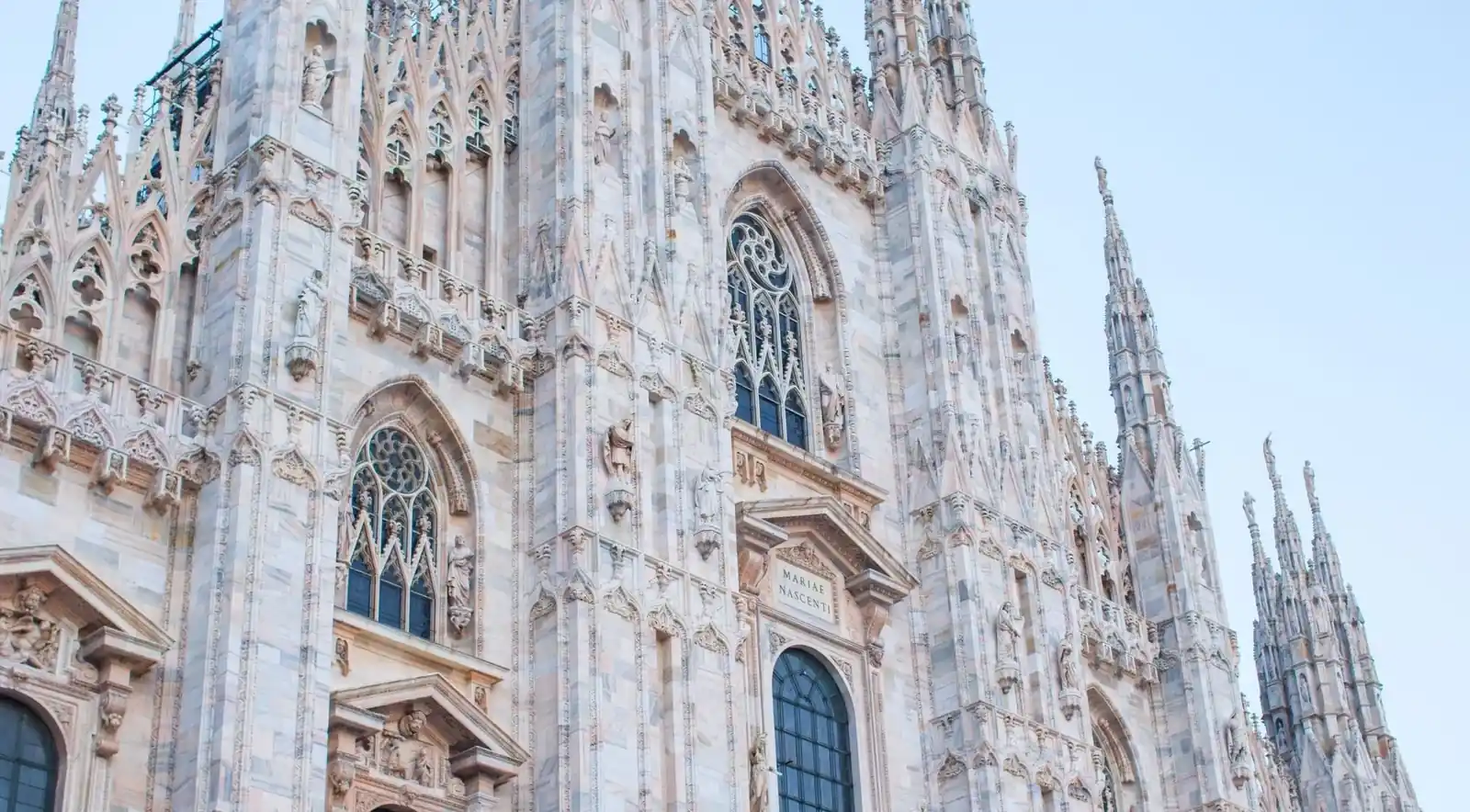
Mark Twain called the Milan Duomo "an anthem sung in stone." That description is more useful than most guidebook summaries, because the interior does not hit you the way a great painting does — with an immediate, concentrated image. It hits you the way music does: gradually, from all directions at once, building until the scale and the silence and the coloured light become something you simply have to stand still and absorb.
This guide is a floor-level tour of that interior — every level, every highlight, every detail that would take months of specialist reading to find and minutes of knowing where to look.
The first impression
Step through the bronze doors and two things happen at once. Your eyes go up, pulled toward the ribbed vaults 45.55 metres overhead — the highest Gothic vaults in any completed church in the world. And they go forward, down the long avenue of marble pillars toward the red glow above the high altar where a nail said to come from the True Cross hangs in a golden reliquary.
The interior is 148 metres long and 57.6 metres wide across its five naves. It can hold 40,000 people. Even when crowded, it feels hushed, because sound disperses into the vastness. The light arrives through 55 monumental stained-glass windows — blue, gold, red, green — and the overall effect is of a cave filled with filtered daylight from a world outside that is richer and stranger than the actual Milan.
Want to explore the interior at your own pace? The official all-areas entrance ticket covers the cathedral, terraces and museum, with an audio guide to the windows and chapels — check availability using the button below.
The floor
Before looking up, look down. The marble floor was designed in 1567 by Pellegrino Tibaldi at the direction of St Charles Borromeo and laid from 1584–85. It uses three stones: pink-white Candoglia marble, black Varenna marble, and red Arzo marble. The geometric pattern — repeating squares with central roses and shell motifs — was laid stone against stone across an area the size of several city blocks. In raking light it reads as three-dimensional.
The meridian sundial
Just inside the entrance, a thin brass line crosses the floor flanked by marble panels bearing the twelve zodiac signs. This is the Duomo's meridian sundial, installed in 1786 by astronomers from the Brera Observatory. A small hole 24 metres up on the south wall lets sunlight fall across the line at solar noon, indicating the season. Until the late 19th century, when the beam crossed the line it triggered a signal relayed to Sforza Castle, where a cannon fired to set the city's clocks. Re-examined in 1976, the sundial still marked solar noon to within two seconds. Almost nobody notices it without being told.
The 52 pillars
The five naves are carried on 52 Candoglia marble pillars — one for each week of the year, by tradition. Each is about 24 metres tall, 3.4 metres in diameter at the base, and brick-cored with a marble cladding. What makes them unique among Gothic cathedrals is the capital: instead of foliage or scrolls, each carries a ring of eight large statues of saints in niches, with further tiers of smaller figures above. A single capital may contain 32 individual stone figures. The effect is of a forest of marble trees blossoming into populated crowns.
The stained-glass windows
The Duomo has 55 monumental stained-glass windows — historiated windows telling biblical and hagiographic stories — representing some 3,600 figures. The oldest date to the early 15th century. The cycle was extended window by window into the 1980s, so five centuries of style exist in continuous glass.
The three apse windows at the east end are the showstoppers: each measures 20.7 × 8.5 metres and ranks among the largest Gothic stained-glass windows in the world. The central window depicts the Vision of the Apocalypse. The lateral windows, largely remade 1833–65 by the Bertini family, tell Old and New Testament stories.
Best time for windows: late morning to midday, when southern sun pours through the south-aisle windows and scatters coloured light across the floor and pillar bases.
St Bartholomew Flayed
In the south transept stands the most arresting object in the cathedral: San Bartolomeo Scorticato (The Flayed St Bartholomew), carved in Carrara marble in 1562 by Marco d'Agrate. The apostle, martyred by being skinned alive, is shown standing upright with his own flayed skin draped over his shoulders like a cloak — at first glance a robe, until you notice the fingernails, the ears, the face of the discarded skin. Every vein, tendon, and muscle is rendered with anatomical precision more appropriate to a medical textbook than a devotional monument.
At the base, d'Agrate signed it with a provocation: NON ME PRAXITELES SED MARCUS FINXIT AGRATES — "Praxiteles did not sculpt me, but Marco d'Agrate." The statue returned from a major restoration in spring 2025.
The Trivulzio Candelabrum
In the north transept rises the Trivulzio Candelabrum, a seven-branched bronze candelabrum more than five metres tall — one of the largest medieval bronzes of this type in the world. Its base (early 13th century, probably Anglo-Norman workshop) is a fantasy of dragons, vines and allegorical figures; the seven branches represent the seven gifts of the Holy Spirit. It arrived around 1550, a gift of Giovanni Battista Trivulzio. Note: the Candelabrum is in the cathedral, not the museum — a persistent source of confusion.
The Medici tomb
On the south transept wall, the funerary monument to Gian Giacomo Medici (the Medeghino, 1498–1555), brother of Pope Pius IV, made by Leone Leoni between 1560 and 1563. A marble architectural frame with bronze standing figures of the deceased flanked by allegories of Peace and War. Long attributed (incorrectly) to Michelangelo — the Michelangelesque influence is real, but the work is entirely Leoni's.
The choir, apse and Holy Nail
The presbytery was redesigned 1575–85 by Pellegrino Tibaldi for St Charles Borromeo. Two massive golden-copper pulpits, supported by bronze caryatids, flank the sanctuary. The wooden choir stalls (completed 1614) are carved with 71 episodes from the life of St Ambrose.
High above the apse, a small red light marks the tabernacle of the Santo Chiodo — the Holy Nail, said to come from the True Cross. Once a year, the Archbishop rises in a cloud-shaped lift (the Nivola) to retrieve it for veneration.
The crypt
Steps behind the high altar descend to the Cappella Feriale, a circular domed winter chapel with marble columns and choir stalls. Adjoining it is the Scurolo di San Carlo — an octagonal chapel built 1606 to hold the remains of St Charles Borromeo (canonised 1610). Its walls are embossed silver panels. At its centre, the silver-and-rock-crystal urn holds the saint's body in pontifical vestments, his face covered by a silver mask. Closed Sundays; additional €3.50 ticket required.
The archaeological area
Down 27 steps near the main entrance, approximately 3.8 metres below the cathedral floor, lies the 4th-century episcopal complex of Roman Mediolanum. The principal structure: the octagonal Baptistery of San Giovanni alle Fonti, built under St Ambrose in 378 AD — the first octagonal baptistery in Christian history, where on Easter night 387 AD Ambrose baptised Augustine of Hippo. The central immersion font, roughly 5.5 metres across, is still clearly legible. Beside it, the apse of the Basilica of Santa Tecla — the cathedral that preceded the Duomo.
Requires Culture Pass (€15) or Fast-Track Pass (€32), or a €5 add-on to any cathedral ticket. Not included in standard Combo tickets — see our tickets guide for the full price breakdown.
Practical tips
Route: Enter and pause for the full nave vista and meridian sundial; walk the right (south) aisle for the oldest windows and St Bartholomew; cross to the north transept for the Trivulzio Candelabrum; visit the choir and apse; descend to the crypt; find the staircase for the archaeological area near the entrance.
Time: 60–90 minutes for a thorough interior visit. Budget 2.5–4 hours for the full complex.
Best light: Late morning for coloured window light across the nave floor. Morning for the apse.
Photography: Personal photos allowed without flash, tripod, or selfie stick.
Dress code: Shoulders and knees covered throughout — including the rooftop. No refund for refusal at entry.
See it with a guide
Milan: Fast-Track Milan Cathedral and Terraces Guided Tour
The interior rewards context. A live guide turns the nave, the windows, St Bartholomew and the archaeology under the floor into a single story instead of a series of unlabelled marvels — then takes you up onto the terraces and leaves you the museum afterward.
- Separate entrance with fast-track cathedral access
- Guided walk through the interior with headsets
- Archaeological area, including the early baptistery remains
- Rooftop terraces by elevator, plus museum access afterward
Keep reading
Related Milan Duomo guides
Tickets
Buying tickets online
Every ticket type, official 2026 prices, where to buy, and the mistakes that cost visitors entry.
Read the guide →Rooftop
Rooftop terraces guide
The 135 spires, the two terrace levels, stairs vs lift, and when to go up.
Read the guide →History
History & Gothic architecture
How a 579-year build produced the most statue-covered building on Earth.
Read the guide →Compare
The guided rooftop tour
Compare the featured fast-track guided tour with self-guided tickets on the homepage.
Compare tours →