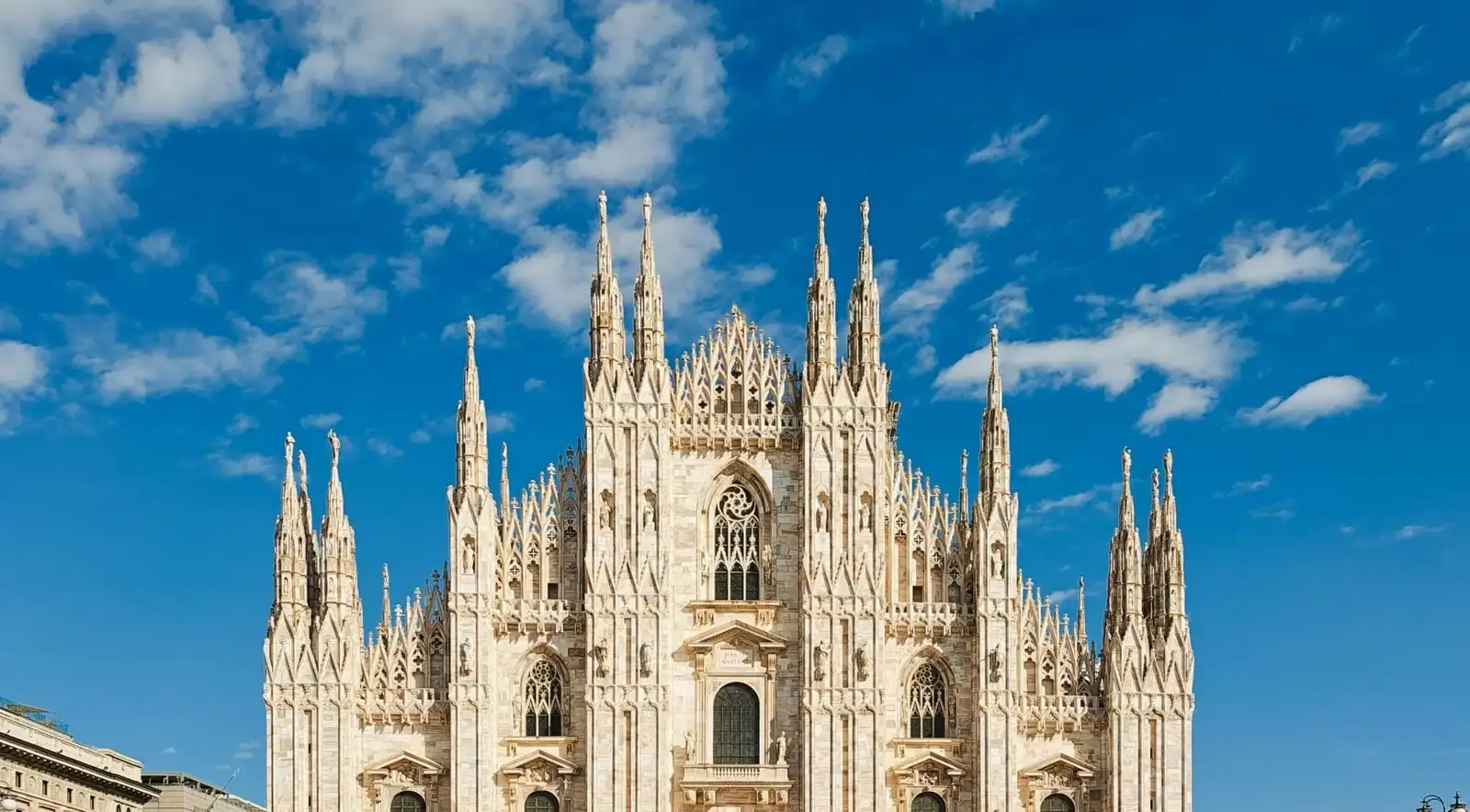
Most visitors to the Milan Duomo look up. The spires, the terraces, the vaults, the Madonnina — the whole building is designed to pull your eyes skyward. But one of the most consequential rooms in Western intellectual history is directly under your feet as you queue on the cathedral steps, and it takes 27 stairs to reach it.
On the Easter Vigil of 387 AD, Bishop Ambrose of Milan baptised Augustine of Hippo in an octagonal immersion font. Augustine was 33. His teenage son Adeodatus and his friend Alypius were baptised alongside him. Within a generation Augustine would write the Confessions and The City of God, books that shaped Western philosophy and the modern idea of the self more than almost any other texts. The font where it happened is still there, still legible, and usually almost empty.
What the archaeological area is
The Area Archeologica del Duomo di Milano is the excavated foundation layer beneath the cathedral and its forecourt — the remains of the early Christian episcopal complex of Roman Mediolanum, the city that served as capital of the Western Roman Empire from 286 to 402 AD. You enter down a 27-step staircase just inside the main doors of the cathedral, on the right as you walk in.
What survives below:
- The Baptistery of San Giovanni alle Fonti — the octagonal 4th-century baptistery, with its central immersion font still clearly readable
- The Basilica of Santa Tecla — the 4th-century "summer cathedral" the Duomo replaced, visible as foundations and apse sections
- The Baptistery of Santo Stefano alle Fonti — the older baptistery, only partly visible
- Sections of early mosaic flooring, tomb structures and architectural fragments
The site was excavated in 1961–63 by Mario Mirabella Roberti, then Superintendent of Antiquities for Lombardy, during the construction of Milan's Metro Line 1. The dig was promoted by Cardinal Giovanni Battista Montini, Archbishop of Milan — the future Pope Paul VI.
The Baptistery of San Giovanni alle Fonti
The baptistery was built under St Ambrose, Bishop of Milan from 374 to 397. The Veneranda Fabbrica dates it to 378 AD; archaeological analysis places it in the last third of the 4th century. It is, by scholarly consensus, the first baptistery in Christendom built on an octagonal plan with an octagonal font — the model that the Lateran Baptistery in Rome, the Baptistery of Florence and countless others would follow.
Ambrose wrote the inscription that explains why: "Octachorum sanctos templum surrexit in usus / octagonus fons est munere dignus eo" — "the eight-niched temple has risen for sacred use; the eight-sided font is worthy of its gift." God created the world in seven days; Christ rose on the "eighth day." The catechumen who steps into eight-sided water symbolically dies and rises with him.
The octagon measured roughly 19.3 metres across the diagonal, with eight wall niches — four rectangular, four semicircular — divided by red porphyry columns about 3.6 metres tall. The central font was around 5.5 metres across and 0.8 metres deep, reached by three steps and fed by running water. In the early 6th century it was redecorated with opus sectile marble flooring and gold-ground mosaics, fragments of which survive.
What you actually see today
Foundations and lower walls, the outline of the niches, fragments of tiled floor and marble decoration — and the octagonal font itself, unmistakable at the centre. The columns, the elevation and the vaults are gone; you read the space as a plan rather than as a building. The payoff here is meaning and context, not visual spectacle. But the font is the anchor, and standing at its rim is a genuinely different experience from reading about it.
Beside it lie the apse and partial walls of the Basilica of Santa Tecla, a five-aisled church some 70 metres long that was Milan's principal cathedral for over a thousand years before demolition began in 1386 to make room for the Duomo. The Duomo's parish is still dedicated to Santa Tecla, and more of the basilica is visible behind glass in the mezzanine of the Duomo Metro station.
Which tickets include the archaeological area
This is the single most common — and most expensive — mistake visitors make down here. The archaeological area is not included in the standard Combo Stairs (€22) or Combo Lift (€26) tickets, and it is not included in the Duomo + Museum (€10) ticket. It is covered by the Culture Pass (€15), the Fast-Track Pass (€32), the Duomo + Ambrosiana ticket (€36) — or by a €5 add-on to any cathedral ticket.
The cleanest route is the official guided tour run by the Veneranda Fabbrica del Duomo, the cathedral's own governing body: its route goes cathedral → terraces by elevator → the archaeological area and the ruins of San Giovanni alle Fonti, with the museum afterwards. It is the only guided option featured here that names the baptistery explicitly.
Visiting on your own? The all-areas entrance ticket covers the cathedral, the terraces and the museum with an audio guide; add the €5 archaeological area supplement to it at the ticket office when you arrive. Our tickets guide has the full 2026 price breakdown.
Practical details
Opening hours: daily 9:00–19:00, last admission 18:10.
Time needed: 20–40 minutes for most visitors on the roughly 150-metre circuit of lit walkways. History enthusiasts can stretch it to an hour.
Atmosphere: cool, quiet and dramatically unlike the nave above. The contrast between Gothic grandeur upstairs and early Christian archaeology below is one of the most effective in Italy — and the space is never crowded.
Photography: personal photos allowed, no flash.
Accessibility: the standard entrance means 27 steps down plus internal steps and catwalks as narrow as 63 cm. A step-free external entrance with a lift exists at the Piazza Duomo / Via Pellico corner, arranged with the ticket office in advance.
When to go: first, before the cathedral fills up. Seeing the 4th-century layer before you walk the nave makes the Gothic cathedral above suddenly intelligible as the latest chapter in a very long story rather than the whole book.
See it with a guide
Milan: Fast-Track Milan Cathedral and Terraces Guided Tour
The archaeological area is the part of the Duomo that most rewards a guide. Without one you are looking at foundations and a shallow stone basin; with one you are standing where Ambrose met Augustine, in the building that gave every later baptistery in Europe its shape. This is the official tour run by the Veneranda Fabbrica itself — the cathedral's own governing body — and its route names the ruins of the Baptistery of San Giovanni alle Fonti explicitly, after the guided cathedral visit and the elevator up to the terraces.
- Archaeological area beneath the cathedral, where the Baptistery of San Giovanni alle Fonti was found
- Separate entrance with a fast-track pass for the cathedral and terraces
- Live guide with headsets through the Gothic interior
- Terraces by elevator, then the Duomo Museum and San Gottardo Church on your own
- 20% discount at the official Duomo shop
Non-refundable. Not suitable for wheelchair users or travelers with mobility impairments — the staircase to the highest terrace is narrow. Dress code enforced (no shorts, short skirts or tank tops), airport-style security checks apply, and the Duomo Museum is closed on Wednesdays. Meeting points vary by option, so check the variant you book.
Is it worth it?
Yes — for anyone with even a passing interest in history, early Christianity or Roman Milan, this is one of the highest-payoff, lowest-crowd stops in the whole complex. The only real reason to skip it is if you have under 90 minutes in total and you came for views and photographs, in which case the rooftop terraces are where your time belongs.
If you do go down, go down first. Then walk back up into the cathedral and read the interior level by level — the meridian sundial, the 52 pillars, St Bartholomew — knowing what was standing on the same ground a thousand years before the first Gothic stone was cut.
FAQ
Frequently asked questions about the archaeological area
Is the archaeological area included in a Duomo rooftop ticket?
No. The standard Combo Stairs (€22) and Combo Lift (€26) tickets do not include it, and neither does the Duomo + Museum (€10) ticket. It is covered by the Culture Pass (€15), the Fast-Track Pass (€32) and most guided cathedral tours, or you can add it to any cathedral ticket for €5. See our tickets guide for the full breakdown.
How long does the visit take?
20–40 minutes for most visitors on the 150-metre circuit of lit walkways. History enthusiasts can spend up to an hour. It is quiet at any time of day.
Was St Augustine really baptised here?
The scholarly consensus, and the Veneranda Fabbrica's official position, is yes: St Ambrose baptised Augustine of Hippo in this octagonal font on the Easter Vigil of 24–25 April 387 AD. Augustine never names the building in the Confessions, so the identification is "very likely" rather than certain.
Is it accessible for wheelchair users?
The standard entrance involves 27 steps down plus internal steps and catwalks as narrow as 63 cm. A step-free external entrance with a lift exists at the Piazza Duomo / Via Pellico corner, but it must be arranged with the ticket office in advance.
Should I see it before or after the cathedral?
Before. The 4th-century layer reframes everything above it — the Gothic cathedral stops being a standalone monument and becomes the latest chapter in a story that starts with Ambrose, Augustine and the Basilica of Santa Tecla.
Keep reading
Related Milan Duomo guides
Interior
Inside the Duomo Milan
What is directly above the baptistery — the nave, the 55 windows, St Bartholomew and the crypt.
Read the guide →Compare
Guided vs self-guided
Is a guide worth the premium? An honest comparison, by visitor type, including the archaeology.
Read the guide →Tickets
Buying tickets online
Every ticket type, official 2026 prices, and which passes actually cover the archaeological area.
Read the guide →History
History & Gothic architecture
What replaced Santa Tecla: 579 years of building the most statue-covered church on Earth.
Read the guide →