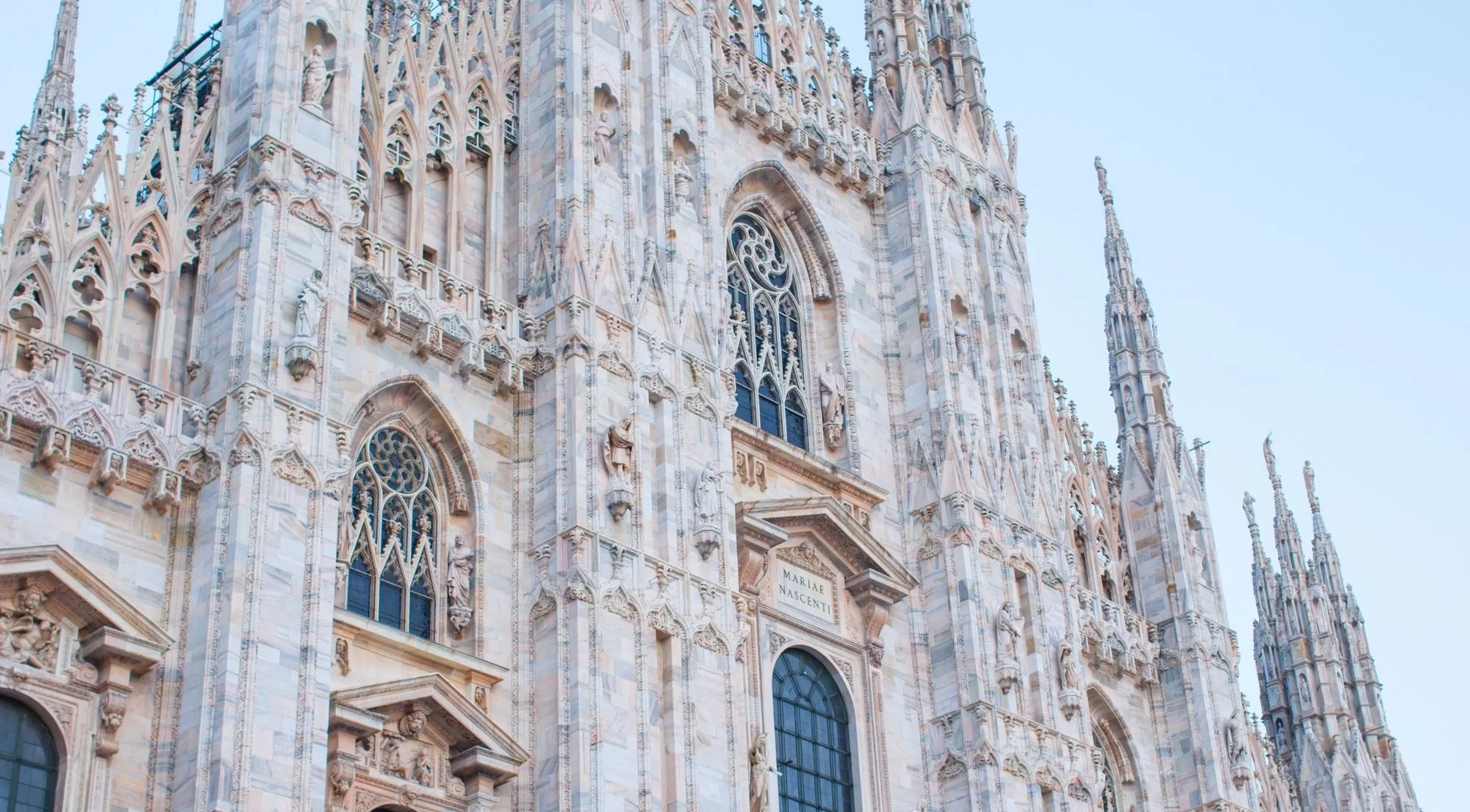
The Grande Museo del Duomo di Milano is one of those places that most people walk past without realising it exists, and that most people who do enter wish they had found sooner. It is not a generic art gallery. It is the official repository of the Milan Duomo — where six centuries of the cathedral's original statues, stained-glass panels, construction models, goldwork and paintings are kept after being removed from the building for conservation.
Almost everything inside was once physically part of the Duomo or made specifically for it. The gargoyle you see at eye level here was removed from a position 40 metres above the piazza, where you couldn't have examined it even with binoculars. The Madonnina's original iron skeleton — the armature that held her copper plates together for 193 years before it was replaced — stands in its own room. For anyone who wants to understand the cathedral rather than just photograph it, this is the essential stop. For anyone who wants views and photos only, it is entirely skippable.
Location and hours
The Grande Museo del Duomo di Milano occupies the ground floor of the Palazzo Reale — the former Royal Palace of Milan, on the right-hand side of the piazza as you face the Duomo façade. The address is Piazza del Duomo 12. (The Duomo's main ticket office, the Sala delle Colonne, is next door at 14/A.)
Hours: 10:00–19:00, closed every Wednesday — this is the single most important practical fact about the museum. Last admission is at 18:00, and rooms are cleared from 18:30.
The Wednesday closure is the most commonly overlooked detail when booking. If your only available day is a Wednesday, do the cathedral and rooftop as usual and plan the museum for another day — combined tickets are valid for two days, so this is easily managed.
Which tickets include the museum
| Ticket | Full price | Includes museum? |
|---|---|---|
| Duomo + Museum | €10 (€8 Wed) | Yes |
| Culture Pass | €15 | Yes |
| Combo Stairs | €22 | Yes |
| Combo Lift | €26 | Yes |
| Fast-Track Pass | €32 | Yes |
| Duomo + Ambrosiana | €36 | Yes |
| Rooftops only (stairs/lift) | €16 / €18 | No |
| Fast-Track Rooftops only | €28 | No |
The museum is not included in standalone Rooftops tickets. Every ticket that includes the cathedral interior includes the museum — except on Wednesdays, when the museum is closed and the Duomo + Museum ticket drops from €10 to €8 to reflect it. Our tickets guide has the full 2026 breakdown, and the stairs-or-lift guide covers the combo tickets that pair the museum with the terraces.
Visiting on your own? The all-areas entrance ticket below covers the cathedral, terraces and museum with an audio guide — the simplest single ticket that includes everything the museum holds.
What the museum contains
First inaugurated in 1953, expanded in the 1960s, then completely redesigned and reopened on 4 November 2013 under architect Guido Canali, the museum spans roughly 2,000 m² across 26 rooms — a chronological journey from the cathedral's 1386 foundation to the 20th century, with over 2,000 works in total.
The Treasury
The visit opens with the Cathedral Treasury: liturgical objects from the 4th to 17th centuries. The finest pieces are the Diptych of the Five Parts (late 5th century), an ivory, gold and gemstone evangeliary cover and the first object in the museum's catalogue; the Situla of Gotofredo (974–979), a carved ivory and gilded-silver liturgical bucket used at the 979 coronation of Otto II; and the Cross of Aribert (early 11th century) in gold, embossed silver, filigree, gems and enamel. Don't rush these rooms — they hold the oldest and most concentrated material in the museum, and they come first, before fatigue sets in.
The original exterior statues
Because Candoglia marble decays in weather and pollution, the Veneranda Fabbrica continuously replaces the exterior statues with identical copies cut in its own workshops, and the originals come here. The effect is extraordinary: details impossible to see from the piazza, or even with binoculars, sit at eye level. Standouts include the San Giorgio (St George) by Giorgio Solari (1403–04), which once topped the cathedral's oldest spire and is said to bear the face of Gian Galeazzo Visconti, alongside Gothic prophets and patriarchs from Burgundian, Rhenish, Bohemian, Campionese and Lombard schools — evidence of the cathedral's pan-European workforce.
The gargoyle room (doccioni) is consistently the most-mentioned favourite in visitor reviews: functional rainwater drains — sea creatures, dragons, hybrid beasts — carved with a specificity that was never meant to be seen from the ground, now displayed where you can examine them.
The stained glass
A dedicated backlit hall displays original 14th–16th-century panels removed from the cathedral windows for conservation. The backlighting makes colours that appear muted at height inside the cathedral suddenly vivid and sharp. Among them are panels from the apse Old Testament window, with cartoons attributed to Giuseppe Arcimboldi — yes, the painter famous for faces made of fruit.
The Modellone
The museum's signature object is the Modellone — an enormous wooden scale model of the entire cathedral in lime wood, walnut and pine, roughly 1:20 scale and about 4 × 8 metres. Work began in 1519 at the Fabbrica's direction, attributed to Bernardo Zenale (with Cristoforo Solari, 1520–24), and continued over three centuries. It functioned as a three-dimensional working blueprint, letting architects and patrons test competing designs before committing to marble. The museum also holds some 23 scale models from the 14th century onward. For anyone interested in how the Duomo was designed and built, it is genuinely jaw-dropping.
Tintoretto's Disputa
The museum's single most important easel painting is Tintoretto's Disputa di Gesù nel tempio (Dispute of Jesus with the Doctors), a large oil on canvas (197 × 319 cm) from the 1540s. It was found in 1955 by the restorer Arcangeli, folded in four in a Fabbrica basement where it had been stored to protect it from World War II bombing. It now has its own room.
The Madonnina's iron skeleton
The original iron armature, built in 1773 by Giovan Battista Varino to support the gilded copper plates of the Madonnina, held the statue atop the main spire for nearly two centuries before being replaced with a stainless-steel structure in 1967. The skeleton — the internal bones of the most recognisable figure in Milan's skyline — is displayed in a dedicated room alongside terracotta models (bozzetti) by sculptor Giuseppe Perego and a walnut-trunk study of the Madonnina's head.
A common confusion: the Trivulzio Candelabrum
The famous 5-metre bronze seven-branched candelabrum is inside the cathedral (north transept), not in the museum. Visitors sometimes expect to find it here — you'll see it on your cathedral interior visit instead.
How long to allow
- Quick pass (Modellone + stained glass + Treasury): 30–40 minutes
- Standard visit: about 60 minutes
- Deep dive (everything, reading the panels): 90 minutes
The museum is never as crowded as the cathedral or the terraces, which makes it a good option for a hot or rainy afternoon when the rooftop is impractical.
Practical details
Accessibility: largely wheelchair accessible via a small ramp in the Palazzo Reale courtyard, with a circular route, lifts and an accessible washroom. The passage from the museum to San Gottardo has steps, but staff can direct you to a step-free alternative.
Photography: allowed for personal use in most rooms, without flash or tripod.
Audio guide: the official DUOMOMILANO app includes a free museum video guide in 12 languages — download it before you arrive, as connectivity inside is variable.
Bookshop: a well-stocked museum bookshop near the exit carries art-history titles, posters and Duomo-related publications.
Is it better than Milan's other museums? It is not a substitute for the Pinacoteca di Brera (Raphael, Caravaggio, Mantegna, Hayez) or the Ambrosiana (Codex Atlanticus, Caravaggio's Basket of Fruit) — those are broad collections. The Duomo Museum is laser-focused on one building, and that focus is its strength. It is essential context for the cathedral; it is not a general art museum.
See the cathedral with a guide first
Milan: Fast-Track Milan Cathedral and Terraces Guided Tour
The museum makes far more sense once you have stood inside the cathedral and up on the terraces — you recognise the statues, the gargoyles and the Madonnina because you have just seen where they belong. This official Veneranda Fabbrica tour walks you through the Gothic interior and up to the terraces with a live guide, then leaves you to explore the Duomo Museum and San Gottardo Church at your own pace afterwards. Just remember the museum is closed on Wednesdays.
- Live guide with headsets through the Gothic interior
- Terraces by elevator via a separate fast-track entrance
- Archaeological area beneath the cathedral
- Duomo Museum and San Gottardo Church on your own afterwards
- 20% discount at the official Duomo shop
Non-refundable. Not suitable for wheelchair users or travelers with mobility impairments — the staircase to the highest terrace is narrow. Dress code enforced (no shorts, short skirts or tank tops), airport-style security checks apply, and the Duomo Museum is closed on Wednesdays. Meeting points vary by option, so check the variant you book.
FAQ
The Duomo Museum: frequently asked questions
Is the museum included in a Duomo ticket?
Every official ticket that includes the cathedral interior includes the museum: Duomo + Museum (€10, €8 Wed), Culture Pass (€15), Combo Stairs (€22), Combo Lift (€26), Fast-Track Pass (€32) and Duomo + Ambrosiana (€36). Standalone Rooftops tickets (€16/€18) and Fast-Track Rooftops (€28) do not include it.
Is the museum closed on any day?
Yes — every Wednesday. Hours are 10:00–19:00, last admission 18:00, rooms cleared from 18:30. Combined tickets are valid for two days, so a Wednesday Duomo day is easily worked around.
How long do you need there?
About 30–40 minutes for a quick pass (Modellone, stained glass, Treasury), ~60 minutes for a standard visit, up to 90 minutes to read everything. It is rarely crowded — good for a hot or rainy afternoon.
What is the most famous object?
The Modellone — a roughly 1:20, 4 × 8 metre wooden model of the whole cathedral, begun in 1519 as a working blueprint. Other highlights: the gargoyle room, Tintoretto's Disputa, the Cross of Aribert and the Madonnina's original iron skeleton.
Where is the museum?
On the ground floor of the Palazzo Reale, the former Royal Palace, on the right-hand side of Piazza del Duomo as you face the façade — Piazza del Duomo 12, next to the ticket office at 14/A.
Keep reading
Related Milan Duomo guides
Interior
Inside the Duomo Milan
The nave, the 55 windows, St Bartholomew and the Trivulzio Candelabrum — where the museum's originals came from.
Read the guide →History
History & Gothic architecture
579 years of building — the Visconti, the Candoglia marble and the Madonnina the museum preserves.
Read the guide →Tickets
Buying tickets online
Every ticket type and official 2026 price, including which passes include the museum.
Read the guide →Rooftop
Stairs or lift
How to reach the terraces, and which combo tickets pair the rooftop with the museum.
Read the guide →