
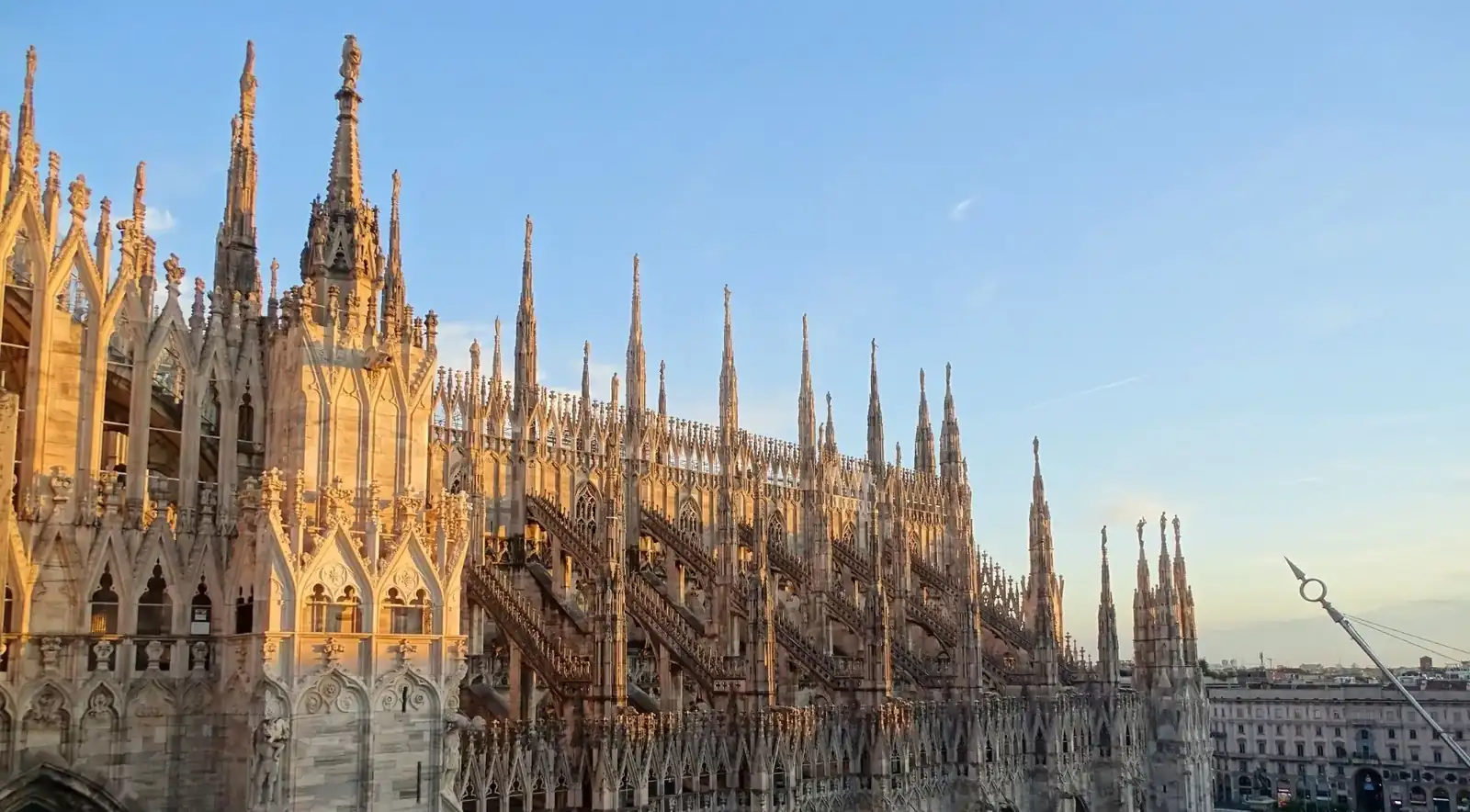
The dress code is enforced by security staff at every entrance to the complex — the cathedral, the rooftop terraces, the underground archaeological area and the museum — and applies to adults and children alike. A refused entry due to clothing is treated the same as any other refusal you caused: the ticket is not refunded.
This guide covers exactly what the code requires, what will get you refused, what to do if you realise on the day that you are not compliant, and why the rule exists.
The rule in plain terms
The Duomo di Milano is an active Catholic cathedral — the seat of the Archbishop of Milan. Visitors are asked to dress with the respect appropriate to a place of active worship. Beyond that, the rule is genuinely minimal for a fashion capital like Milan.
What must be covered:
- Shoulders — both, for all genders. No sleeveless tops, tank tops, spaghetti straps or off-shoulder garments. A bag strap does not count as coverage.
- Knees — both legs covered to the knee or below. No shorts above the knee, no mini-skirts, no mid-thigh dresses.
- Midriff — no crop tops or exposed midsections.
- Chest — no deeply plunging necklines or see-through fabric over the upper body.
Additionally restricted inside the cathedral, crypt and archaeological area (acceptable on the open-air rooftop):
- Hats and caps — must come off inside; fine on the terraces.
- Sunglasses — a courtesy to remove indoors, not strictly enforced.
No specific colours, no specific fabrics, no modesty rule beyond shoulders and knees. That is the entire code.
What will get you refused entry
Guaranteed refusal: sleeveless tops of any kind, shorts above the knee, mini-skirts and short dresses, crop tops, see-through tops without a solid layer underneath, and bikini tops worn as outerwear.
Likely refusal, at staff discretion: very low-cut tops, sheer fabric without coverage-equivalent layering underneath, and shorts that are borderline at the knee once the waistband sits low.
What staff will not refuse you for: colour, short (but present) sleeves, tight clothing, jeans or leggings, and any closed footwear.
A common misunderstanding: the rooftop
The dress code applies on the open-air rooftop terraces exactly as it does inside the cathedral — this surprises many visitors, who assume outdoor space is exempt from a "church" rule. It is not. Security checks compliance at the rooftop entrance separately from the cathedral entrance, which matters because people often change plans mid-visit: compliant in the morning for the cathedral, then back in shorts and a vest for the afternoon rooftop climb — and refused at the second entrance just as firmly as the first.
The code also applies in the Duomo Museum and the underground archaeological area. Enforcement is slightly less rigorous at the museum entrance (in the Palazzo Reale rather than the cathedral itself), but the rule is technically identical.
What to do if you're not compliant on the day
Buy a cover-up at the ticket office. The Veneranda Fabbrica sells disposable fabric wraps at Ticket Office 1 (Sala delle Colonne), Piazza del Duomo 14/A — inexpensive, designed for exactly this situation, and staff are used to the request.
Buy a scarf from a piazza vendor. Stalls around Piazza del Duomo sell lightweight scarves aimed squarely at this market. One scarf, worn over the shoulders and wrapped at the waist, solves both problem areas and can be reused for the rest of the trip.
Return to your accommodation and change, if you are staying nearby and have time — a regular T-shirt and knee-length trousers or a dress is all it takes.
Reschedule, if none of the above works. Tickets bought through GetYourGuide often include free cancellation up to 24 hours in advance — a useful safety net for exactly this situation.
Why the rule exists
The Duomo is not a museum that happens to look like a church — it is one of the world's largest active Catholic cathedrals, the mother church of the Diocese of Milan, where Masses, baptisms and diocesan ceremonies take place continuously. The dress code is not an Italian quirk aimed at tourists; the same rule applies at almost every major Italian cathedral, from the Pantheon to Santa Maria Maggiore. Understanding this makes the rule feel less like a barrier and more like what it is: a thirty-second courtesy for a space that is simultaneously a heritage site and an active place of worship.
The practical wardrobe for a Duomo visit
Summer (June–September): a short- or long-sleeved T-shirt (not sleeveless), light trousers or a knee-length dress, flat rubber-soled shoes for the uneven, sometimes hot marble, a hat and sunglasses to carry, and sunscreen applied before you leave.
Spring and autumn (March–May, September–October): jeans or trousers with a T-shirt or light shirt, plus a light jacket — the rooftop is consistently cooler and windier than the piazza below.
Winter (November–February): standard winter clothing already satisfies the code; add a warm jacket, hat and gloves specifically for the exposed terraces, removing the hat before entering the cathedral.
The bag rule — not dress code, but checked at the same point
Large bags, suitcases and wheeled luggage are not permitted anywhere in the complex, and there is no cloakroom on site. A small daypack around 30×30×15cm is fine. If you are arriving with more, use a left-luggage service near Piazza del Duomo before your visit.
Featured guided tour
Milan: Fast-Track Milan Cathedral and Terraces Guided Tour
Now that your outfit is sorted, this is the official Veneranda Fabbrica tour that ties the cathedral, terraces, archaeological area and museum into one route with a licensed guide — the same body that enforces the dress code is the one running the tour.
- Separate entrance plus a fast-track pass for the cathedral and terraces
- Live guide with headsets through the Gothic interior
- Elevator to the terraces, then walking among the spires
- Archaeological area below the Duomo
- Duomo Museum and San Gottardo Church on your own afterwards
Non-refundable. Not suitable for wheelchair users or travelers with mobility impairments — the staircase to the highest terrace is narrow. Dress code enforced (no shorts, short skirts or tank tops), airport-style security checks apply, and the Duomo Museum is closed on Wednesdays.
FAQ
Frequently asked questions about the dress code
Does the dress code apply to the rooftop terraces?
Yes. The terraces are part of the same complex, and you will be checked at the rooftop entrance even if you already passed the cathedral entrance in compliant clothing.
Can I wear a hat on the rooftop?
Yes. Hats are fine on the open-air terraces. Remove them when you descend into the cathedral interior.
Will they refund my ticket if I'm refused for dress code?
No. The Veneranda Fabbrica treats dress-code refusals as the visitor's responsibility, and tickets are not refunded — which is exactly why it is worth knowing the rule before you arrive.
Is a sleeveless sundress acceptable with a cardigan?
Yes, provided the cardigan covers the shoulders and the hemline reaches the knee. A shorter dress would also need a wrap or trousers underneath.
Do children have to comply?
Yes, the same rules apply at every age. Most children's summer clothing already complies — the usual gap is a sleeveless top, easily solved with a light T-shirt.
Can I wear shorts if the rule says "knees covered"?
Shorts that genuinely reach the knee are fine. Most standard summer shorts sit above it — longer walking or Bermuda-length shorts are the safer bet.
Keep reading
Related Milan Duomo guides
Plan ahead
Opening hours & prices
Every opening time in the complex, the full 2026 price table, and when to actually go.
Read the guide →Tickets
Buying tickets online
Every ticket type, where to buy safely, and six mistakes that cost visitors entry.
Read the guide →Rooftop
Rooftop terraces guide
The 135 spires, the two terrace levels, stairs vs lift, and the best time to go up.
Read the guide →Compare
Guided vs self-guided
Is a guide worth the €10–€30 premium? The honest answer by visitor type.
Read the guide →