There is a moment on the rooftop of the Milan Duomo that nobody warns you about.
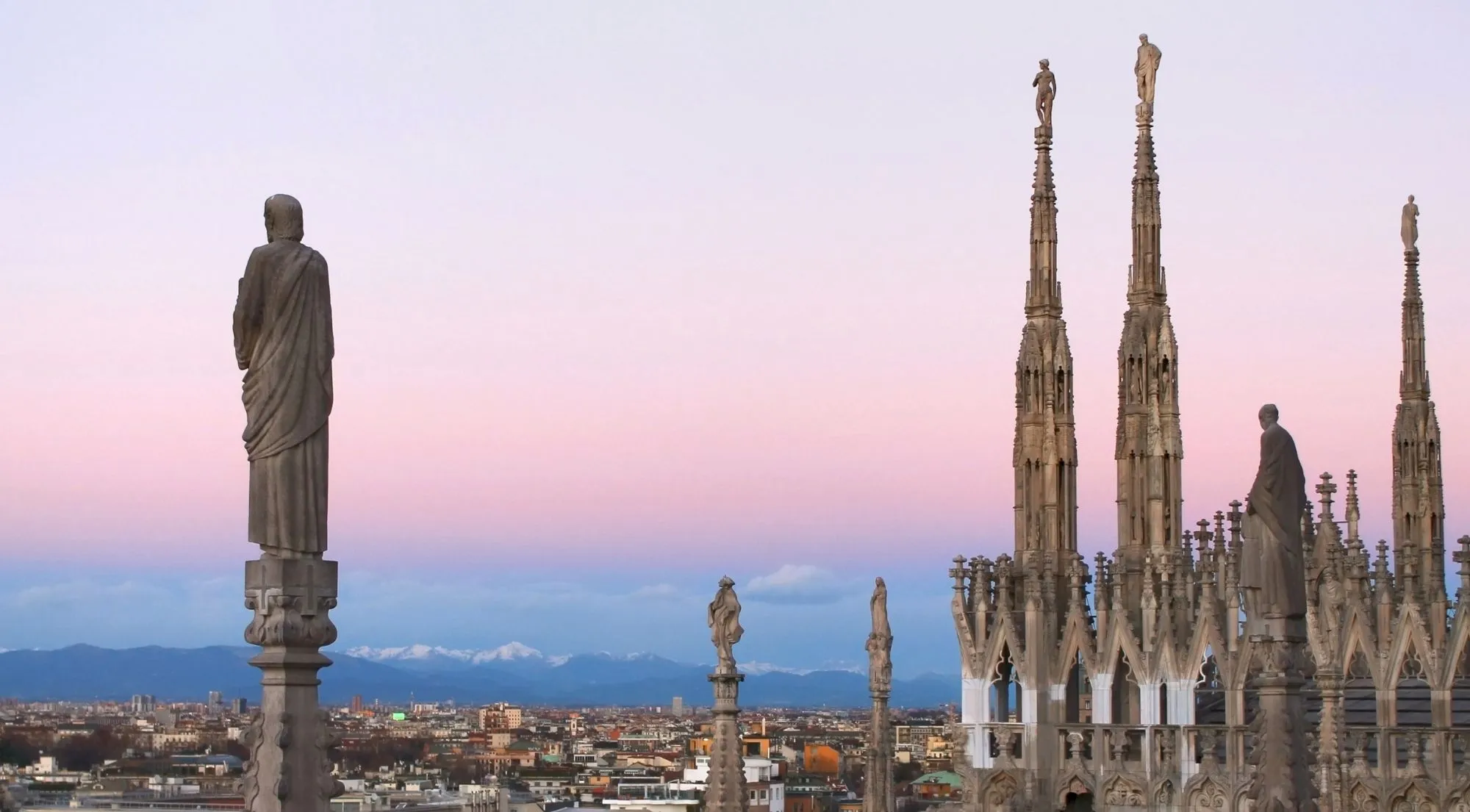
You emerge from the staircase — or step out of the lift — and you are suddenly surrounded by them. Not looking up at them from the piazza far below, not peering at them through binoculars, not seeing them on a postcard. You are in the middle of them: 135 marble spires rising around you in every direction, each one crowned with a statue, each one carved from the same pink-veined Candoglia marble as the cathedral beneath your feet. Gargoyles lean over the edge at eye level. Saints look down from plinths at your shoulder. And somewhere above it all, 108.5 metres up, the gilded Madonnina floats against the Milan skyline.
This is the only fully walkable Gothic cathedral roof on Earth. Not a viewing platform bolted to the side of a building. Not a distant observation deck. The actual roof — the one the medieval stonemasons built, the one six centuries of pilgrims have walked, the one photographers travel from across the world to stand on.
This guide covers everything you need to know before you book: what the terraces actually contain, how to reach them, which ticket to buy, when to go, and what to look for once you're up there.
What the rooftop terraces are
The terraces — Terrazze del Duomo in Italian — are the accessible outer surfaces of the cathedral's roof, running between and among the flying buttresses and spires. This is not an observation deck added to give tourists a view. It is the structural roofline of the building, built between the 14th and 19th centuries, and walking on it means walking on the same surface that cathedral workers, stonemasons and restoration crews have used for 600 years.
The scale is harder to grasp until you are there. The Duomo's roof covers roughly 8,000 square metres — equivalent to about 16 tennis courts placed end to end. The central viewing area alone (the Belvedere) covers some 1,530 square metres, comparable to the entire floor area of the main nave below. You don't look at the spires from the terraces. You walk among them.
The visit is one-directional: you ascend at one end of the cathedral and descend at the other, following a marked circuit that winds between buttresses, around the central spire cluster, and along both sides of the roof before the descent staircase deposits you back inside the cathedral. The whole circuit takes 45–60 minutes at a comfortable pace, though the Veneranda Fabbrica suggests budgeting up to two hours for those who want to linger.
Want a guide up on the roof with you? The featured fast-track tour adds a separate entrance, live commentary, and the cathedral and museum to your terrace visit — check live availability below.
What you'll see: the marble forest
The 135 spires
The most immediately overwhelming thing about the roof is the spires. There are 135 of them — most standing roughly 17 metres tall, tapering into pointed finials, each built on top of a flying buttress. Every spire is topped with a statue of a saint, biblical figure, prophet, or historical person. Taken together, the Duomo carries more than 3,400 statues across its exterior — the most of any building in the world — plus 150 gargoyles, 96 "giants," and hundreds of carved corbels, capitals and decorative details.
From street level, these are white marble shapes against the sky. From the roof, they are life-sized, arm's-reach figures with faces, hands, expressions and individual carving quality that ranges from the simply functional to the genuinely extraordinary. A 15th-century prophet's robes still show the chiselled folds of fabric. A gargoyle's open mouth still channels rainwater through stone carved into the shape of a dragon's throat. A saint's halo still catches the morning light.
The Carelli spire
Look for the oldest spire — the Guglia Carelli, positioned on the north side and topped by San Giorgio (Saint George). This is the first spire ever constructed on the Duomo, dating to 1403–04, built using funds left by the Milanese merchant Marco Carelli, who bequeathed 35,000 gold ducats to the Fabbrica in 1390. The original St George statue, carved by Giorgio Solari, is now in the Duomo Museum (replaced by a copy on the spire); it is said to bear the face of Gian Galeazzo Visconti, the Duke who commissioned the cathedral. One spire among 135, but the one that started them all.
The gargoyles — how they work
The stone monsters leaning from the edges of the roof are functional as well as decorative. The Italian term doccione comes from doccia (shower), and these figures are rainwater drainage channels — their open mouths channel roof water away from the marble walls, preventing the kind of water damage that would accelerate the Candoglia marble's decay. The aquatic and monstrous forms (sea creatures, dragons, hybrid beasts) follow a long Gothic tradition of giving protective roles to liminal, apotropaic figures. One of the most famous, a mermaid riding a sea monster (c. 1747), was restored in the 20th century and remains one of the best-photographed details on the roof.
The counter-façade staircase
On the staircase descending from the terraces at the western end — the side closest to the Piazza del Duomo — look carefully at the carved details on the wall beside the steps. Visitors have noted the carved faces of Dante Alighieri, an icepick, a rope and a racket among the decorative stonework — odd objects incorporated into a Gothic cathedral, and one of the many small puzzles the Duomo rewards close attention with.
The Madonnina
At 108.5 metres above the piazza, the Madonnina stands on the apex of the Guglia Maggiore — the cathedral's tallest and central spire. She is not accessible to visitors (that platform is for maintenance only), but from the Central Terrace at 45 metres you are closer to her than from anywhere below, and the effect is genuinely different from looking up at her from street level. She is a 4.16-metre gilded copper statue of the Virgin of the Assumption, designed by sculptor Giuseppe Perego in the early 1770s and hoisted into position on 30 December 1774. The original iron framework that held her copper plates together for nearly two centuries is now displayed in the Duomo Museum; it was replaced with a stainless steel armature in 1967.
Her significance to Milan goes far beyond decoration. By tradition — and from the 1930s by building regulation — no building in Milan should rise above her. The tradition survives into the present: when the Pirelli Tower went up in the late 1950s, a replica Madonnina was placed on its roof. The same logic applies to the Palazzo Lombardia (161m) and the Allianz Tower (209m) — each carries a small copy of the Madonna so she effectively presides over the city's entire skyline.
The view from the top
From the Central Terrace (the Belvedere) at approximately 45 metres, the view covers:
The city. Piazza del Duomo is directly below — you can identify the glass roof of the Galleria Vittorio Emanuele II, the Teatro alla Scala, and the radiating streets of central Milan. Further out, the Velasca Tower (the distinctive mushroom-shaped 1950s skyscraper), Sforza Castle to the northwest, and the Porta Nuova glass towers to the north.
The Alps. On clear days, the full arc of the Alps is visible on the northern horizon — the Matterhorn, Monte Rosa, and the Bernina range in good visibility. This view is seasonal and weather-dependent. It is most reliable October through April, especially in the hours after a rain front clears the Po Valley's notorious industrial and agricultural haze. In July and August, haze makes the Alps invisible on most days.
The cathedral itself. The most disorienting pleasure of the roof is looking down into it as much as out. Through gaps in the stone you can glimpse the nave below. The spires cluster so densely around the central area that you find yourself inside an abstract stone forest, with the city visible only through the gaps between pinnacles.
The two terrace levels
Most visitors experience the terraces as a single entity, but there are effectively two main accessible heights:
The Lower Terraces — the walkways running the perimeter of the roof at approximately 31 metres above the piazza. These run the length of both sides and offer good views, and they are where the lift deposits you.
The Central Terrace (Belvedere) — at approximately 45 metres, reached by two steep flights of steps from the lower terraces. This is the main event: the highest accessible level, eye-to-level with the tallest pinnacles and closest to the Madonnina. Roughly 50 additional steps beyond what the lift provides get you here.
The accessible route for wheelchair users reaches only the lower terrace level, via the South Lift, daily between 10am and 5pm, and must be arranged with staff in advance. The Belvedere's final staircase is not accessible by lift for tourists.
How to get up there: stairs vs elevator
You have four ticket options for rooftop access:
Stairs (on foot, ~251 steps): The stairs entrance is on the south side of the cathedral, separate from the main façade. The ascent takes 10–15 minutes at a comfortable pace through an enclosed, one-way masonry staircase. There are limited views from the staircase itself — the payoff is at the top. Stairs users join the circuit at the same first-level walkway as lift users, then climb the additional ~50 steps to the Belvedere.
Lift (elevator): Two compact lifts on the south side — the standard North Lift (capacity ~7 people) and the fast-track South Lift. The ride is rapid — under two minutes to the first terrace. Then the same ~50 additional steps to the Belvedere. Both ascent options descend by the same staircase — the down-lift is reserved exclusively for wheelchair users who arrange it in advance.
Fast-Track: A priority lane through the South Lift, reducing wait times. Worth it on peak summer weekends; rarely necessary in shoulder season.
The queue for the lift is almost always longer than the queue for the stairs, particularly in peak season. Most able-bodied visitors report that the stairs — 10–15 minutes of moderate exercise — are the better choice by time and cost.
Tickets and prices (2025–2026 official rates)
| Ticket | What it includes | Price |
|---|---|---|
| Rooftops by stairs | Terraces only (no cathedral, no museum) | €16 / €8 reduced |
| Rooftops by lift | Terraces only (no cathedral, no museum) | €18 / €9 reduced |
| Combo Stairs | Cathedral + Rooftops (on foot) + Museum | €22 / €11 reduced |
| Combo Lift | Cathedral + Rooftops (by lift) + Museum | €26 / €13 reduced |
| Fast-Track Rooftops (lift) | Terraces via priority lift (no cathedral) | €28 / €14 reduced |
| Fast-Track Pass | Everything + priority entry | €32 / €16 reduced |
The critical distinction: The standalone Rooftops tickets (€16/€18) give you the terraces only — you cannot enter the cathedral interior with them. If you want both the roof and the cathedral (most visitors do), buy the Combo version. For the full ticket breakdown and where to buy, see our guide to buying Duomo tickets online.
Since 1 April 2025, the Veneranda Fabbrica has eliminated all online booking fees. The price on the official portal (ticket.duomomilano.it) is identical to the price at the on-site ticket desk. Buy in advance to guarantee your timed slot, not to save money.
When to go
Opening hours: 9:00–19:00 daily. Last ascent 18:10. Extended to 20:00 on Fridays, Saturdays and Sundays from 5 June to 13 September 2026.
Early morning (9:00–10:30) ★★★★★
The consistent answer for almost every visitor type. First slot means the smallest crowds, the calmest light, and the coolest temperatures on the marble. In summer, this is also the window before the terraces become genuinely uncomfortable — by late morning in July and August, the marble is hot enough to radiate heat through rubber soles. Book the 9am slot. Arrive at the entrance five minutes early. If you are on a Combo ticket, do the rooftop first — it is the most time-sensitive part of the visit — then descend into the cathedral and museum at your leisure.
Sunset and late afternoon ★★★★☆
The terraces at golden hour are extraordinary — the Candoglia marble turns warm gold, the Madonnina glows, and the long shadows of the spires fall across the walkways. This is the light that makes Duomo rooftop photography iconic. The trade-off: late afternoon is also when day-trippers arrive for a final visit, and the terraces in the last 90 minutes before closing can be busier than mid-morning. In summer 2026, Friday/Saturday/Sunday evening openings until 8pm extend the window and spread the crowd.
Summer heat advisory
The Veneranda Fabbrica has issued a formal health advisory for summer 2026 rooftop visits: visitors with cardiovascular or respiratory conditions are specifically advised to avoid midday access (roughly noon–5pm) from mid-June through mid-September. A medical aid station staffed by Auxologico is on site from 15 June–13 September, noon–5pm. Fresh water is available on the terraces during these periods.
What to bring
Footwear: Flat, rubber-soled shoes with grip. The marble is irregular and becomes slippery when wet. Heels are impractical and dangerous.
Layers: Even in summer, the terraces are exposed and breezy. The temperature differential between the piazza and the roof can be 5–8°C, and wind chill makes it feel colder. A light jacket in a day bag makes the difference between 45 minutes and two hours.
Sun protection: Above the city's street-level shade, UV exposure is significantly higher. Sunscreen, sunglasses and a hat are essential from March through October.
Camera: A wide lens captures the spires-and-skyline panorama; a longer focal length picks out individual statues and gargoyle details. Tripods and selfie sticks are not permitted. Flash is not permitted inside the cathedral.
Water and snacks: There are no food or drink points on the rooftop terraces. Carry water — especially in summer. There are cafés on Piazza del Duomo for before and after.
Dress code
The Duomo is an active cathedral and the dress code applies to the entire complex — including the open-air rooftop terraces. This surprises many visitors. Shoulders must be covered. Knees must be covered. No sleeveless tops, no shorts above the knee, no see-through fabrics. Hats and sunglasses are acceptable outdoors on the terraces (not inside the cathedral). You will be turned away at security if your clothing violates the code, and pre-booked tickets are not refunded for dress-code violations.
A practical solution in summer: wear what you like and carry a lightweight scarf or sarong. Disposable cover-ups are available at the Sala delle Colonne ticket office (Piazza del Duomo 14/A), and scarves are sold cheaply at stalls around the piazza.
What people get wrong
"The lift takes you all the way up." It doesn't. The lift deposits you on the first terrace (~31m). You still climb roughly 50 additional steps to the Central Terrace (Belvedere). Descent is always by stairs regardless of how you went up, unless you are a wheelchair user who arranged the down-lift in advance.
"A Rooftops ticket includes the cathedral." It doesn't. The standalone terraces tickets (€16/€18) are rooftop access only. If you want the cathedral interior and the museum as well, you need a Combo ticket.
"You can see the Alps." You can — but only on clear days, and most reliably October through April. In summer haze they are invisible most of the time. Don't plan your visit around the Alps, but be prepared to be delighted if they appear.
"The terraces close when it rains." Not always. Light rain keeps the terraces open but the marble gets slippery. Closures happen in thunderstorms, high winds, or icy conditions. The Fabbrica will notify ticket holders if a closure is expected.
"The dress code doesn't apply on the roof." It does. You will be turned away at the entrance if your clothing is not compliant — and the ticket refund policy does not cover dress code refusals.
Book your rooftop access
Milan: Cathedral and Duomo's Terraces Entrance Ticket
The all-areas entrance ticket is the most flexible way onto the terraces: cathedral, rooftop and museum on one official ticket, with a timed slot you reserve before you travel. Pick a morning slot, go straight up to the roof first, then come back down for the interior at your own pace.
- Official all-areas access at face value
- Rooftop terraces, cathedral and Duomo Museum
- Audio guide to the windows and Church of St Gottardo
- Timed entry reserved in advance
Prefer a live guide and a separate fast-track entrance? Compare the guided cathedral and terraces tour on GetYourGuide.
FAQ
Frequently asked questions about the rooftop
How long does the rooftop visit take?
Most visitors spend 45–60 minutes. The Veneranda Fabbrica suggests up to two hours for those who want to explore every walkway and linger at the details. With a guided tour, budget 60–90 minutes for the rooftop section.
Is the rooftop safe for children?
Yes — the terraces have guardrails along the outer edges and the walkways are wide enough to be comfortable. Children must be supervised; young children should be held on the narrower sections. There is no minimum age restriction.
Should I take the stairs or the lift?
The stairs (~251 steps, 10–15 minutes, €2 cheaper) usually have a shorter queue. The lift reaches only the first terrace (~31m); you still climb ~50 steps to the Belvedere. Most able-bodied visitors find the stairs the better choice on time and cost.
Can I book just the rooftop, or do I have to do the cathedral too?
You can book rooftop access alone (€16 stairs / €18 lift). You don't have to enter the cathedral. However, most visitors combine both — the Combo tickets (€22/€26) offer significantly better value and include the museum as well.
Is the rooftop accessible for wheelchair users?
The lower terraces are accessible via the South Lift, daily 10am–5pm, arranged in advance with the ticket office. The Central Terrace (Belvedere) is not accessible by lift for tourists — the final ascent involves ~50 steps. Wheelchair users and one companion enter free with proof of disability.
What happens if the roof is closed due to weather?
If the Veneranda Fabbrica closes the terraces due to weather, affected ticket holders receive notification and options for rebooking or refund. If you have a non-refundable booking through a third-party reseller, check the cancellation terms before you book.
Keep reading
Related Milan Duomo guides
Tickets
Buying tickets online
Every ticket type, official 2026 prices, where to buy, and the mistakes that cost visitors entry.
Read the guide →Interior
Inside the Duomo Milan
What to see once you come back down — the nave, the windows, the crypt and the archaeology.
Read the guide →History
History & Gothic architecture
Why there are 135 spires and 3,400 statues, and how the Madonnina came to crown the city.
Read the guide →Compare
The guided rooftop tour
Compare the featured fast-track guided tour with self-guided tickets on the homepage.
Compare tours →